Engineering Reliable Connections: How Push-in Terminal Blocks Maintain Consistent Contact Pressure
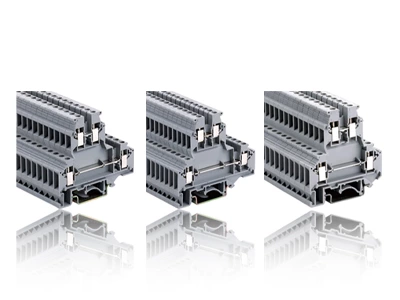
Reliable electrical connectivity hinges on the stability of contact pressure. In modern industrial automation, the push in type terminal block has become a standard due to its ability to provide secure, vibration-proof connections without the need for manual tightening. This stability is not accidental; it is the result of precision spring-cage engineering designed to withstand harsh environments.
The Mechanics of Constant Contact Force
The consistent contact pressure in a push fit terminal block is primarily generated by a high-tension stainless steel spring. When a conductor is inserted, the spring is deflected, creating a continuous reactive force that presses the wire against the copper current bar. Unlike screw-type terminals, which can loosen over time due to thermal expansion or mechanical vibration, the spring mechanism automatically compensates for these changes, ensuring the contact resistance remains low and stable throughout the device's lifecycle.
| Component | Material Property | Function |
| Spring Clamp | High-tensile Stainless Steel | Provides permanent elastic force |
| Current Bar | Electrolytic Copper (Tin-plated) | Ensures maximum conductivity |
| Housing | Polyamide (PA 6.6) | Offers insulation and thermal stability |
Why Push Fit DIN Rail Terminals Excel in Industrial Environments
The adoption of push fit din rail terminals in control cabinets has surged because they address the three primary challenges of electrical termination: speed, safety, and maintenance.
-
Vibration Resistance: The spring-loaded design is inherently resistant to loosening, making it ideal for applications in railway, marine, and heavy machinery sectors.
-
Uniformity: Since the pressure is determined by the spring’s physical properties rather than a technician's torque, every connection is identical.
-
Reduced Heat Generation: By maintaining a constant force, the interface minimizes voltage drops and prevents the localized heating that often leads to component failure.
Optimizing Performance with Quality Materials
To ensure long-term stability, the internal architecture of the push in type terminal block utilizes materials with high fatigue resistance. The spring must be capable of maintaining its elastic modulus even after repeated cycles of insertion and removal. Furthermore, the surface treatment of the conductive parts prevents oxidation, which is crucial for maintaining the integrity of the contact point in humid or corrosive atmospheres.
By eliminating human error in the tightening process, these components provide a "fit and forget" solution that significantly lowers the total cost of ownership for complex electrical systems. Whether you are wiring a simple distribution box or a sophisticated PLC system, understanding the physics behind the pressure ensures a safer, more efficient installation.