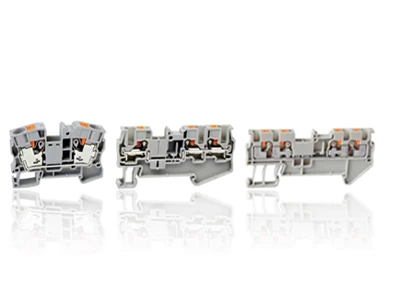
Material Analysis Of Push Fit Din Rail Terminals: Pa66+30% Gf Vs. Standard Pa66
The main difference between standard PA66 and PA66+30% glass fiber (GF) lies in mechanical strength and thermal stability. Adding 30% GF to a push fit terminal block increases tensile strength to approximately 150 MPa and raises the heat deflection temperature up to 250°C, suiting high-vibration and extreme temperature environments.
Standard PA66 Base Properties
Standard Polyamide 66 offers excellent electrical insulation and inherent flame retardancy for a typical push in type terminal block. It operates reliably within a continuous temperature range of -40°C to 105°C. This polymer provides adequate flexibility, preventing housing cracks during regular installation and basic maintenance operations in standard indoor industrial control panels.
PA66+30% Glass Fiber Enhancements
Mechanical and Thermal Upgrades
Injecting 30% glass fibers fundamentally transforms the polymer matrix structure. Tensile strength nearly doubles compared to standard unreinforced versions. The heat deflection limit also significantly increases. These enhanced traits allow push fit din rail terminals to maintain strict dimensional stability under heavy mechanical stress and high-temperature conditions exceeding 120°C continuously.
Application Selection Criteria
Select the appropriate housing material based on specific environmental demands and operational conditions:
-
Standard panel operations: Select unmodified PA66 for cost-effective, general-purpose internal wiring tasks.
-
Heavy machinery installations: Specify PA66+30% GF housings to resist severe operational vibrations and shock.
-
Extreme temperature zones: Utilize glass-reinforced plastics near industrial furnaces, transformers, or high-power motor drives.