Disassembly Of The Contact Mechanics And Repeatability Characteristics Of Separable Connectors
Electrical grid failure often stems from a 50% drop in interface pressure at medium-voltage cable joints. Managing contact force in separable connectors directly prevents localized overheating and sudden power outages. Maintaining strict mechanical repeatability across multiple mating cycles ensures long-term grid stability and optimal current transfer.
What is the Optimal Contact Force for Separable Connectors?
The optimal contact force for industrial separable connectors typically ranges between 40 and 70 Newtons. This specific force range ensures that the electrical contact resistance remains below 10 micro-ohms, preventing thermal runaway while avoiding mechanical deformation of the internal copper or aluminum pins during installation and operation.
Factors in Separable Insulated Connectors Performance
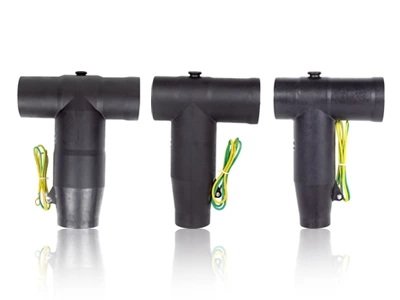
Contact resistance directly dictates power loss and thermal generation. High-quality separable insulated connectors utilize engineered compression profiles to sustain consistent physical pressure against environmental stress.
Mechanical Characteristics of the Contact Interface
-
Oxide film penetration: Sufficient mechanical pressure breaks through non-conductive surface oxides, establishing reliable metal-to-metal contact patches.
-
Thermal expansion absorption: The elastomer shell can absorb volume changes during peak loads without losing contact pressure.
-
Micro-arcing prevention: Stable interface force eliminates microscopic air gaps, neutralizing the risk of partial discharge.
Enhancing Repeatability in Screened Separable Connectors
Achieving uniform electrical performance over 50 mating cycles requires strict geometric tolerance. High-voltage screened separable connectors achieve this through robust material selection and specialized conductive outer layers.
Maintenance Protocols for Consistent Mating
-
Apply specified lubricants: Utilize exact 5-gram dosages of silicone grease to lower friction coefficients during insertion.
-
Verify alignment angles: Ensure axial alignment within 5 degrees to prevent uneven wear on the female receptacle.
-
Measure torque limits: Tighten mechanical fasteners to exactly 30 Newton-meters using calibrated tools.
Operational Indicators to Monitor
-
Insertion force profiles: Track deviations from the baseline 150-Newton insertion standard.
-
Mating surface integrity: Inspect the conductive rubber screen for cuts, abrasions, or particulate contamination.
-
Contact resistance baselines: Record micro-ohm values immediately following every single reconnection procedure.
Eliminating Interface Degradation in Underground Networks
Stress relaxation in copper alloys accounts for nearly 35% of connection failures over a 30-year operational lifespan. Deploying screened separable connectors equipped with stainless steel reinforcing rings mitigates this material fatigue. Implementing these precise mechanical adjustments eliminates unexpected power disruptions, lowers operational costs, and extends network longevity.