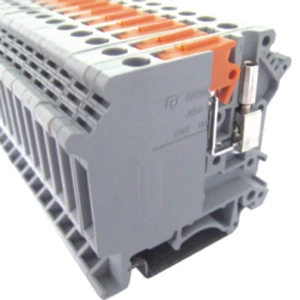
Knife vs Quick-Disconnect Terminal Blocks: Which One Fits Your Circuit?
Choosing between a knife disconnect terminal block and a quick disconnect terminal block depends on three factors: conductor type, switching frequency, and visual status indication. For solid conductors and low-frequency switching, a knife disconnect terminal block is the better choice. For flexible conductors and frequent maintenance access, a quick disconnect terminal block offers faster operation. For applications requiring clear visual confirmation of circuit status, the knife type provides an unmistakable orange or red indicator element.
Knife Disconnect Terminal Blocks – When to Specify Them
A knife disconnect terminal block uses a pivoting insulated blade that physically breaks the current path when rotated with a standard screwdriver. This design is suited for circuits rated at 16 A or higher, where a robust mechanical break is required.
Key applications:
-
Main control circuits and power distribution branches
-
Current transformer secondary circuits (where safe isolation is mandatory)
-
Circuits requiring visible confirmation of the disconnected state
Advantages: The disconnect status is clearly visible through a colored indicator (orange or red). Operation requires only a standard screwdriver—no special tools needed.
Limitation: Frequent switching (hundreds of operations per week) can accelerate mechanical wear on the knife mechanism.
Quick Disconnect Terminal Blocks – When to Choose Them
Quick disconnect terminal blocks feature a lever or push-pull mechanism that can be actuated by hand, without tools. This makes them ideal for signal circuits and applications where maintenance personnel need to open and close circuits repeatedly.
Key applications:
-
Sensor and actuator signal loops (4-20 mA, 0-10 V)
-
Flexible conductors and fine-stranded wires
-
Control cabinets where frequent testing and reconfiguration occur
Advantages: Tool-free operation with a finger lever; faster switching than screwdriver-actuated types.
Limitation: Lower current ratings (typically 10–16 A) and less obvious visual status indication compared to knife types.
Selection Quick Reference
| Comparison Aspect | Knife Disconnect | Quick Disconnect |
|---|---|---|
| Actuation method | Screwdriver | Finger lever |
| Conductor type | Solid, ferrule-terminated | Flexible, fine-stranded |
| Current range | 16 – 32 A | 10 – 16 A |
| Status visibility | Clear (colored indicator) | Position-dependent |
| Switching frequency tolerance | Low to moderate | High |
| Typical use | Main circuits, CT circuits | Signal loops, sensors |
Four Technical Parameters That Matter in Selection
-
Rated current vs. actual carrying capacity – A terminal rated at 16 A may require derating when ambient temperature exceeds 40°C. Always check the temperature-current curve in the product documentation rather than relying solely on the front-page rating.
-
Conductor range – three distinct values – Terminal blocks specify three conductor ranges: minimum solid, maximum solid, and minimum/maximum flexible (with ferrule). These values are often different. Inserting a flexible conductor without a ferrule into a terminal rated only for solid wires can increase contact resistance beyond acceptable limits.
-
Operating force and mechanical endurance – Knife disconnect terminal blocks typically require 0.5–0.6 N·m of torque for actuation. Mechanical endurance is usually specified in thousands of operations. Both factors directly affect field maintenance experience.
-
Test socket compatibility – Disconnect and test terminal blocks feature standardized test sockets, typically 2 mm or 4 mm in diameter. Verify compatibility with existing test leads and banana plugs before specification.
A Field Scenario: What a Disconnect Terminal Block Saves
Consider a control cabinet where a 4-20 mA signal loop stops transmitting. With a standard feed-through terminal, the troubleshooting sequence is: power down → loosen screw terminals → remove wires → measure → reconnect → power up. Total time: 15–20 minutes, with reconnection errors possible.
With a disconnect and test terminal block installed:
-
Step 1: Actuate the disconnect mechanism (2 seconds) – the circuit is isolated
-
Step 2: Insert test leads into the terminal's test sockets (5 seconds) – measure the signal
-
Step 3: Determine whether the fault is in the sensor or the wiring
-
Step 4: Close the disconnect mechanism (2 seconds) – circuit restored
Time saved: 15–20 minutes compressed to 2–3 minutes. For production lines where downtime costs thousands per minute, this difference translates into measurable operational savings.
Safety value: All operations occur with the circuit de-energized at the terminal level—no exposed live conductors, no arc flash risk from probing energized circuits.
Frequently Asked Questions
Q: Can disconnect terminal blocks be operated under load?
A: The disconnect mechanism is designed for no-load or low-load operation. Unless the product documentation explicitly states "load-break capability," the circuit should be de-energized upstream before actuating the disconnect. This is a safety requirement, not a product limitation.
Q: Are knife disconnect and test disconnect terminal blocks the same thing?
A: Not exactly. A knife disconnect terminal block focuses on the disconnection function—using a knife blade to break the circuit. A test disconnect terminal block adds standardized test sockets to the disconnect function, enabling measurement on both sides of the disconnect point. The two can be combined: a basic disconnect terminal block with a test plug inserted becomes a test disconnect terminal block.
Q: Can a disconnect terminal block be converted into a fuse terminal block?
A: Yes. Basic disconnect terminal blocks feature a standardized disconnect zone that accepts interchangeable function plugs. Inserting a fuse plug converts the terminal into a fused terminal block. Inserting a feed-through connector converts it back to a pass-through terminal. This modularity means one terminal type serves multiple functions, reducing inventory complexity.
Q: What standards apply to disconnect and test terminal blocks?
A: The primary reference is IEC 60947-7-1 (low-voltage switchgear and controlgear – terminal blocks for copper conductors), which includes specific requirements for test disconnect terminal blocks in Annex D. For North American markets, UL 1059 covers terminal blocks rated 1500 V or less. For hazardous environments, ATEX or IECEx certification may be required.