Fuse Terminal Blocks: Slash BOM Costs and Panel Space with 1 Component
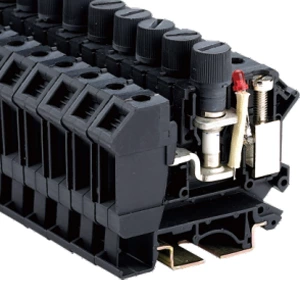
Integrating a fuse holder and a wiring terminal into a single DIN rail device reduces component SKUs by 50% and cuts average panel assembly time by up to 18% per connection point. A fuse block terminal consolidates circuit protection and wire connection into one housing, eliminating separate fuse holders and their mounting hardware.
Fuse terminal blocks are the preferred choice for control panels where space constraints, rapid fuse replacement, and standardized wiring are primary concerns. The terminal block fuse holder mounts directly on a DIN rail and incorporates a fuse carrier within the terminal body.
Where Fused Terminals Outperform Traditional Holders
High-Vibration Environments
In railway rolling stock or onboard vehicle equipment, a fuse terminal with screw-clamp termination provides sustained vibration resistance that independent fuse holders cannot match. The Reakdyn self-locking principle prevents screw loosening under constant movement, ensuring stable, high-pressure conductor clamping.
Caution: In high-vibration scenarios, select screw-clamp versions over push-in designs to prevent micro-movements that cause intermittent connections and nuisance tripping.
High-Density Panel Layouts
Compact automation equipment benefits from the bridge shaft design found on many fuse terminal blocks. These allow potential distribution across multiple units using plug-in bridges, eliminating the need for complex jumper wiring between separate fuse holders and terminals. The result is a cleaner panel with fewer point-to-point connections.
Selection Guide: Match Connection Type to Application
Choosing the right terminal block fuse holder depends less on current ratings alone and more on the mechanical demands of your installation environment.
| Connection Type | Vibration Resistance | Ideal Application Scenario |
|---|---|---|
| Screw-clamp | Excellent | Railway, heavy machinery, shipbuilding with constant movement |
| Push-in (Spring) | Moderate | High-volume production lines, robotic cells, clean automation |
For offshore projects, the PA66 housing of a fuse terminal provides necessary resistance to salt-mist corrosion—a factor often overlooked in standard datasheets. The JHD5 series terminals typically accommodate wire ranges up to 16mm² and support both U-type and G-type DIN rail mounting.
Beyond Ratings: Visual Indication and Safe Isolation
1. Instant Fault Feedback (LED)
Many fuse block terminal models include an LED indicator that illuminates when the fuse opens. This reduces troubleshooting time from minutes to seconds, allowing maintenance crews to locate blown fuses at a glance without powering down entire sections.
2. Secure Disconnect for Testing
Built-in test sockets allow voltage or continuity measurements without removing wires. This prevents thread stripping from repeated screw loosening and retightening—a common failure point in traditional fuse holder setups.
3. Global Compliance
Devices carrying UL, CSA, and CE approvals confirm compliance with international safety standards for overcurrent protection. This ensures smooth project acceptance across global installations without last-minute compliance surprises.
The Hidden Savings in Fused Terminal Adoption
Inventory Overhead
Consolidating two SKUs—fuse holder and terminal block—into one fuse terminal line item reduces warehouse picking errors and simplifies kitting for panel assembly stations.
Assembly Labor
Installing one component instead of two directly cuts the number of torque wrench operations per connection point. With push-in or spring-cage options, tool-free termination further reduces assembly time.
Maintenance Simplicity
Standardizing on one fuse terminal blocks family simplifies spare parts management. Maintenance teams no longer search through cluttered cabinets for separate fuse clips—the fuse is right where it belongs, integrated into the terminal.
Next Steps for Panel Optimization
Before finalizing your selection, review the power dissipation curve for fuse terminal units operating at temperatures above 50°C. Derating factors significantly impact long-term reliability in enclosed panels with limited airflow. The terminal's metallic components—typically high-strength copper alloy for screws and electrolytic copper for current bars—are surface-treated with tin or nickel plating to resist corrosion.
Consult the technical datasheet for derating curves under higher ambient temperatures and verify that the selected fuse block terminal accommodates your preferred fuse type, whether 5x20mm, 6.3x32mm, or automotive blade formats.