Push-in Vs Screw: 3.6s Vs 13.5s Per Wire On Servo Drives
For a servo drive with 20 termination points, switching from screw terminals to a push in terminal block cuts total wiring time from roughly 4.5 minutes to under 1.5 minutes. Connecting a solid wire with a push-in type terminal block takes 3.6 seconds, compared to 13.5 seconds for a screw connection. The difference comes down to one thing: no screwdriver, no torque adjustment, no re-tightening later.
What makes push-in terminal blocks faster for servo drives?
The mechanism is straightforward. A push fit terminal block uses a spring clamp that engages the conductor immediately upon insertion. Solid wires or stranded wires terminated with ferrules insert directly into the terminal opening. The spring maintains constant contact pressure without requiring tools or torque verification.
Test Data: Speed, Pull-Out Force, and Vibration
| Connection Method | Solid Wire | Flexible Wire | Flexible Wire w/ Ferrule |
|---|---|---|---|
| Screw Terminal | 13.5s | 14.4s | 13.2s |
| Push-In Terminal | 3.6s | 4.1s | 3.7s |
Source: Push-in design termination time comparison
Beyond speed, push-in terminal blocks deliver measurable mechanical advantages:
-
Pull-out force – 250N, five times the IEC requirement. This means wires stay locked under tension, even in high-vibration environments.
-
Vibration resistance – Tested to IEC/EN 60068-2-6 standards at frequencies up to 2000Hz and accelerations up to 20g. Spring clamp connections maintain zero microsecond contact interruptions across three orthogonal axes.
-
Insertion force – Reduced by 50% compared to conventional spring-clamp products, which lowers operator fatigue during repetitive wiring tasks.
Electrical Specifications for Servo Drive Applications
| Parameter | Rating | Application Relevance |
|---|---|---|
| Rated Impulse Withstand Voltage | 8kV | Overvoltage Category III |
| Pollution Degree | 3 | Industrial environment standard |
| Flammability Rating | UL 94 V-0 | PA66 insulation material |
| Conductor Range | 24 – 10 AWG | Covers signal and power lines |
| DIN Rail Compatibility | NS 35/7.5, NS 35/15 | Standard 35mm rail profile |
The 8kV rated impulse withstand voltage ensures protection against voltage transients commonly found in servo drive power circuits. Pollution Degree 3 rating confirms suitability for industrial environments where conductive dust or moisture may be present. UL 94 V-0 flammability rating provides fire safety assurance for panel-mounted components.
Step-by-Step: Wiring a Servo Drive with Push-In Terminals
-
Remove the terminal block from the servo driver – Wiring with the terminal block mounted can damage the driver.
-
Strip 8 to 9 mm of insulation from the end of each wire.
-
For stranded wires, crimp a ferrule – Prevents individual strands from splaying during insertion.
-
Insert the wire directly into the terminal opening – solid wires and ferruled wires require no tools.
-
Give the wire a light pull to verify mechanical locking – the spring clamp engages immediately.
-
Mount the terminal block back onto the servo driver.
DIN Rail Integration and Installation
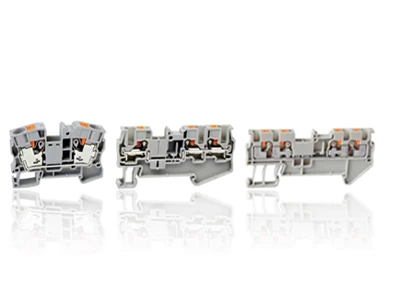
Most industrial servo drives mount inside cabinets with 35mm DIN rails (EN 60715). The push fit din rail terminals slide directly onto NS 35/7.5 and NS 35/15 profiles without additional mounting hardware. Double-level and triple-level variants allow multiple circuits to terminate within a narrow footprint – a density advantage critical for space-constrained servo cabinets.
Limitations and Precautions
The push in type terminal block is not a universal replacement for every application:
-
Conductor size – Optimal performance is achieved on conductors up to 4–6 mm². For larger gauges (>6 mm²), screw-clamp terminals remain the preferred option.
-
Stranded wires require ferrules – Inserting bare stranded wires without ferrules can cause individual strands to splay, increasing contact resistance and reducing mechanical retention.
-
Extreme vibration environments – While push-in terminals pass 20g / 2000Hz vibration testing, additional measures such as anti-vibration clamps are recommended for applications with sustained mechanical shock.
-
Disconnection – Releasing a wire requires pressing the release button or inserting a tool into the release opening. Never pull the wire out by force.
Long-Term Operational Benefits
Beyond the initial installation time savings, push-in terminal blocks eliminate routine maintenance tasks. No scheduled torque checks. No re-tightening after thermal cycling or equipment moves. No connection failures traced to undertorqued screws.
For facilities running multiple servo-driven machines, these savings compound across every preventive maintenance interval and every emergency repair. The total cost of ownership for push-in terminal blocks consistently undercuts screw-terminal solutions when labor rates and downtime costs are factored in.