
Cold Shrink Cable Accessories: Silicone vs EPDM Selection Guide
- Reference standards:
- JB/T7829,JB/T 7830
- AC Withstand Voltage for 5 min:
- 8 kV,no breakdown
- Heating Cycles Test in Air:
- 4.5 kV, heating cycles at least 8 h, 95–100 ℃ for at least 2 h, natural cooling for at least 3 h, total 30 heating cycles
- Heating Cycles Test Under Water:
- 4.5 kV, heating cycles at least 8 h, 95–100 ℃ for at least 2 h, natural cooling for at least 3 h, total 30 heating cycles
- AC Withstand Voltage:
- 7.2 kV,4 h no breakdown
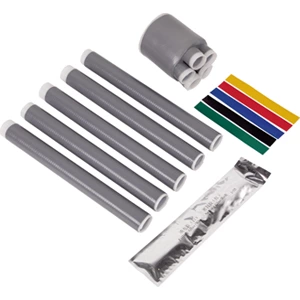


Choose silicone for overhead lines, solar farms, and extreme cold (down to -60°C). Choose EPDM for direct burial, underground conduits, and ozone-rich environments like substations. Both deliver IP68-rated waterproof protection and meet IEC 60502-4 type testing requirements for extruded power cable accessories.
Quick Comparison: Silicone vs EPDM
| Property | Silicone Rubber | EPDM Rubber |
|---|---|---|
| Continuous temperature range | -60°C to +200°C | -40°C to +150°C |
| UV resistance (2,000 hrs) | Contact angle drops ~8% | No degradation (with additives) |
| Ozone resistance | Moderate | Excellent |
| Mechanical strength (abrasion/puncture) | General | Superior |
| Hydrophobicity | Live, self-recovering | Static, additive-dependent |
| Typical shrink ratio | Up to 5:1 | Up to 4:1 |
| Best-suited installation | Overhead, high-altitude, solar farms | Direct-buried, substations, industrial plants |
Three-Step Material Selection Process
Step 1: Identify the primary environmental stress
-
Strong UV exposure (overhead lines, solar fields) → Silicone
-
Ozone environment (near transformers, switchgear) → EPDM
-
Mechanical abrasion risk (direct burial with rock backfill) → EPDM
-
Extreme low temperature (below -40°C) → Silicone
Step 2: Verify the operating temperature range
-
Continuous operation above +150°C or below -40°C → silicone only
-
Standard range -40°C to +105°C → both materials perform reliably
Step 3: Assess installation conditions
-
Irregular cable profiles requiring wide diameter tolerance → silicone (elongation >800%)
-
Rough handling environments with abrasion risk → EPDM (higher tear strength)
Material Anti-Aging Mechanisms
Silicone Rubber: Si-O Backbone Stability
The siloxane (Si-O) backbone delivers bond energy of approximately 451 kJ/mol—higher than carbon-carbon bonds at 348 kJ/mol—providing inherent resistance to photo-oxidative degradation. Live hydrophobicity enables the material to recover water repellency after contamination or corona discharge. This explains why silicone-based cold shrink cable accessories consistently perform in high-altitude and high-UV environments.
EPDM: Saturated Hydrocarbon Defense
The ethylene-propylene backbone with limited diene sites creates a saturated polymer chain. Ozone attacks only the diene locations, leaving the main chain intact. EPDM cold shrink tubing delivers exceptional ozone resistance and superior mechanical toughness against abrasion and puncture. For direct burial applications requiring IP66 waterproof, dustproof, and corrosion resistance, EPDM is the preferred choice.
Performance by Installation Scenario
Overhead and Outdoor Installations (High UV, Rain, Temperature Swings)
Silicone demonstrates superior weatherability in ultraviolet radiation resistance and anti-aging performance. Its hydrophobic properties increase surface resistance and flashover voltages of terminations. EPDM can be formulated with UV additives, but long-term UV protection may diminish over time. For cold shrink termination on overhead lines, silicone is the standard recommendation.
Direct Burial and Underground (Moisture, Corrosion, Mechanical Load)
EPDM withstands physical stress from sharp rocks and rough handling during installation. Its scratch resistance, waterproof performance, and moisture resistance exceed silicone alternatives. EPDM cold shrinkable tube products maintain sealing integrity under soil pressure and groundwater exposure, making them ideal for underground networks.
Industrial and Substation Environments (Ozone, Chemical Exposure)
EPDM's ozone resistance provides a decisive advantage in substation settings with high ozone concentration. Silicone offers excellent resistance to organic solvents and chemical compounds, while EPDM performs well against acids and alkalis. When selecting cold shrink tubing for switchgear areas, EPDM is often the safer choice.
Installation and Handling Characteristics
Silicone Advantages
-
High expansion ratio with low permanent set value
-
One size accommodates broader cable diameter ranges
-
Suitable for emergency repairs with complex site conditions
EPDM Advantages
-
Higher tear strength resists installation damage
-
More tolerant of rough field handling
-
Ideal for wilderness and tunnel installations
Common Benefits
-
No open flame or heat gun required
-
Suitable for petrochemical, mining, and other hazardous zones
-
Instant IP68-rated seal upon installation
Voltage Rating and Product Selection
0.6/1 kV Low Voltage Cold Shrink Accessories
These products suit low-voltage distribution systems and are compatible with PVC, XLPE, and EPR insulated single-core, two-core, three-core, four-core, and five-core power cables. Both silicone and EPDM options are available. Selection depends primarily on installation environment—outdoor vs. indoor, direct burial vs. overhead. For cold shrink termination in low-voltage networks, either material can be specified based on the site's dominant stress factor.
Medium Voltage Applications (6 kV – 35 kV)
Outdoor terminations: silicone preferred (UV resistance, tracking resistance). Intermediate joints: either material, based on burial conditions. Both meet IEEE 404 standard requirements for extruded dielectric shielded cable joints rated 2.5 kV to 500 kV.
Technical FAQ
Q: Which material performs better at -40°C?
A: Silicone. Its glass transition temperature is approximately -120°C, maintaining elasticity at -60°C. EPDM's low-temperature limit is approximately -55°C.
Q: Can EPDM be used for overhead outdoor lines?
A: Yes, but UV additives are required and long-term protection may degrade. Silicone is the preferred choice for outdoor overhead applications, especially for cold shrink tubing exposed to continuous sunlight.
Q: What is the service life of each material?
A: EPDM cold shrink tubing typically delivers 15+ years of service. Silicone offers comparable longevity with superior performance in high-temperature applications but costs 30–40% more than EPDM equivalents.
Q: How long can cold shrink cable accessories be stored?
A: Most cold shrink cable accessories have a shelf life of 3 years from the manufacturing date when stored under recommended conditions. This applies to both silicone and EPDM cold shrinkable tube variants.
0.6/1 kV Fully Cold Shrink Three-Core Terminal – Installation Outline Drawing

 |
 |
| 0.6/1 kV Five-Core Cold Shrink Terminal – Supporting Drawing | 0.6/1 kV Five-Core Cold Shrink Joint – Supporting Drawing |
Electrical Performance Tests
| No. | Test Item | Standard Requirements |
| 1 | AC Withstand Voltage for 5 min | 8 kV,no breakdown |
| 2 | Heating Cycles Test in Air | 4.5 kV, heating cycles at least 8 h, 95–100 ℃ for at least 2 h, natural cooling for at least 3 h, total 30 heating cycles |
| 3 | Heating Cycles Test Under Water | 4.5 kV, heating cycles at least 8 h, 95–100 ℃ for at least 2 h, natural cooling for at least 3 h, total 30 heating cycles |
| 4 | AC Withstand Voltage | 7.2 kV,4 h no breakdown |
| 5 | Reference Standards | JB/T7829,JB/T 7830 |
Product overview
◆The product is available in single-core, two-core, three-core, four-core, and five-core versions, and has been widely used for low-voltage cable terminations and intermediate connections.
◆Excellent surface hydrophobicity, ensuring the product maintains strong resistance to contamination.
◆Compact size, lightweight, and reliable performance.
◆Application Scope: The product demonstrates excellent cold and heat resistance, making it particularly suitable for high-altitude, cold, humid, salt-spray, and heavily polluted environments.
Installation requires no open flame, making it ideal for flammable and explosive areas such as petroleum, chemical, mining, and tunneling sites.
Technical Data - Model Selection
| Product Type | Model | Conductor Cross-section(mm²) | Product Type | Model | Conductor Cross-section(mm²) |
| 0.6/1 kV Single-Core Cold Shrink Termination | GHD-1LS-1*10-16 | 10-16 | 0.6/1 kV Single-Core Cold Shrink Joint | GHD-1JTLS-1*10-16 | 10-16 |
| GHD-1LS-1*25-50 | 25-50 | GHD-1JTLS-1*25-50 | 25-50 | ||
| GHD-1LS-1*70-120 | 70-120 | GHD-1JTLS-1*70-120 | 70-120 | ||
| GHD-1LS-1*150-240 | 150-240 | GHD-1JTLS-1*150-240 | 150-240 | ||
| GHD-1LS-1*300-400 | 300-400 | GHD-1JTLS-1*300-400 | 300-400 | ||
| 0.6/1 kV Two-Core Cold Shrink Termination | GHD-1LS-2*10-16 | 10-16 | 0.6/1 kV Two-Core Cold Shrink Joint | GHD-1JTLS-2*10-16 | 10-16 |
| GHD-1LS-2*25-50 | 25-50 | GHD-1JTLS-2*25-50 | 25-50 | ||
| GHD-1LS-2*70-120 | 70-120 | GHD-1JTLS-2*70-120 | 70-120 | ||
| GHD-1LS-2*150-240 | 150-240 | GHD-1JTLS-2*150-240 | 150-240 | ||
| GHD-1LS-2*300-400 | 300-400 | GHD-1JTLS-2*300-400 | 300-400 | ||
| 0.6/1 kV Three-Core Cold Shrink Termination | GHD-1LS-3*10-16 | 10-16 | 0.6/1 kV Three-Core Cold Shrink Joint | GHD-1JTLS-3*10-16 | 10-16 |
| GHD-1LS-3*25-50 | 25-50 | GHD-1JTLS-3*25-50 | 25-50 | ||
| GHD-1LS-3*70-120 | 70-120 | GHD-1JTLS-3*70-120 | 70-120 | ||
| GHD-1LS-3*150-240 | 150-240 | GHD-1JTLS-3*150-240 | 150-240 | ||
| GHD-1LS-3*300-400 | 300-400 | GHD-1JTLS-3*300-400 | 300-400 | ||
| 0.6/1 kV Four-Core Cold Shrink Termination | GHD-1LS-4*10-16 | 10-16 | 0.6/1 kV Four-Core Cold Shrink Joint | GHD-1JTLS-4*10-16 | 10-16 |
| GHD-1LS-4*25-50 | 25-50 | GHD-1JTLS-4*25-50 | 25-50 | ||
| GHD-1LS-4*70-120 | 70-120 | GHD-1JTLS-4*70-120 | 70-120 | ||
| GHD-1LS-4*150-240 | 150-240 | GHD-1JTLS-4*150-240 | 150-240 | ||
| GHD-1LS-4*300-400 | 300-400 | GHD-1JTLS-4*300-400 | 300-400 | ||
| 0.6/1 kV Five-Core Cold Shrink Termination | GHD-1LS-5*10-16 | 10-16 | 0.6/1 kV Five-Core Cold Shrink Joint | GHD-1JTLS-5*10-16 | 10-16 |
| GHD-1LS-5*25-50 | 25-50 | GHD-1JTLS-5*25-50 | 25-50 | ||
| GHD-1LS-5*70-120 | 70-120 | GHD-1JTLS-5*70-120 | 70-120 | ||
| GHD-1LS-5*300-400 | 150-240 | GHD-1JTLS-5*150-240 | 150-240 | ||
| GHD-1LS-5*300-400 | 300-400 | GHD-1JTLS-5*300-400 | 300-400 |
