How Can Terminal Block Accessories Enable Online Circuit Testing Without Power Interruption?
- Material:
- PA
- Flammability rating (UL 94):
- V0
- Mounting:
- Compatible with standard 32 mm or 35 mm DIN rails (EN 60715)
- Color:
- gray
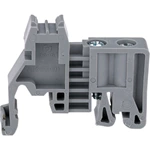
Live circuit testing does not require powering down every time. One scheduled shutdown for accessory installation enables all subsequent measurements without interrupting operation. Test plugs insert into dedicated sockets on terminal blocks, establishing parallel contact with the current bar while conductors remain fully terminated. Readings proceed with zero downtime and zero wire disturbance.
Essential Terminal Block Accessories for Safe In-Circuit Testing
A complete test-ready assembly depends on several mechanical and electrical components working together.
Rail Mounting and Insulation Components
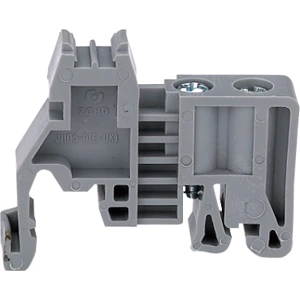
An end clamp terminal block secures the terminal strip to the DIN rail. It prevents lateral movement that could stress conductors or loosen terminations over time. TH35-7.5 rails conform to DIN EN 60715 and accept end clamps with a tightening torque range of 0.4 to 0.6 Nm. Polyamide construction with UL94 V-0 flammability rating delivers dielectric strength and fire resistance for demanding industrial environments.
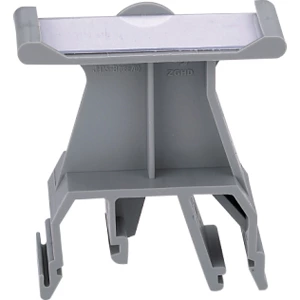
An end plate terminal block shields exposed conductive parts at strip ends. It reduces short-circuit risks and satisfies touch-safe requirements. The plate also provides a flat surface for marking strips, enabling clear circuit identification at assembly boundaries.
Power Distribution and Sealing Solutions
A jumper bar for terminal block systems creates electrical continuity across adjacent positions. Common potentials—neutral lines or control supply voltages—distribute without individual wire loops.
Available configurations:
-
Comb-style jumpers insert directly into current bar contact slots
-
Staggered jumpers serve alternating-position bridging patterns
-
Insulated versions prevent accidental contact with adjacent components
Rated current reaches 32 A for high-power applications. The PA66 housing resists heat, impact, and wear for long service life.
A terminal block end cap covers open terminal faces or protects the final position in a strip. It keeps dust out and prevents accidental probe contact with live parts. The cap snaps onto the housing and maintains the assembly's IP20 finger-safe rating.
Step-by-Step Workflow for Online Measurements
Performing an online measurement follows a straightforward sequence:
-
Initial setup (offline): Power down the panel. Install test plug adapters permanently into the function slots of relevant terminal blocks. Tighten all mechanical fasteners to specified torque values.
-
Verify continuity: Use a multimeter to confirm the adapter contacts the current bar in parallel with the conductor termination. No open circuit condition should exist.
-
Restore power: Energize the system. The adapters remain in place without affecting normal operation.
-
Insert the test plug: For routine diagnostics, insert the insulated test plug into the adapter socket. The 4 mm size suits standard multimeter leads; the 2.3 mm version fits tight spaces and works with spring-cage terminals.
-
Take the reading: The plug contacts the current bar independently of the conductor termination. No interruption occurs. No voltage drop is introduced.
-
Remove the plug: The terminal block returns to normal operation with no residual effect on connection integrity.
Troubleshooting: Why Readings May Fluctuate
Measurement instability often traces to accessory condition rather than circuit faults.
-
⚡ Unstable readings? Check whether the end clamp terminal block has loosened from vibration. Retighten to 0.4–0.6 Nm.
-
🔥 Excessive voltage drop? Verify the jumper bar for terminal block cross-section matches the circuit's current draw. Undersized jumpers introduce resistance.
-
🛡️ Low insulation resistance? Inspect the terminal block end cap for cracks or heat damage. Replace any degraded polyamide components.
-
📉 Intermittent contact? Confirm test plug pins are clean and fully seated. Dust or oxidation on contact surfaces produces erratic readings.
Accessory Selection Quick Reference
| Accessory | Primary Function | Critical Parameter | Typical Application |
|---|---|---|---|
| Test plug adapter | Permanent test point | 4 mm / 2.3 mm socket | Continuous monitoring |
| Service plug | Temporary access | Insulated housing | Periodic diagnostics |
| End bracket | Rail anchoring | 0.4–0.6 Nm torque | Assembly stability |
| Insulating plate | End insulation | UL94 V-0 rated | Safety barrier |
| Bridge bar | Potential distribution | 32 A rated | Power sharing |
Compliance with International Testing Standards
All test procedures must align with IEC 61010-1, which specifies safety requirements for electrical equipment used in measurement, control, and laboratory applications. Terminal blocks within this standard's scope must demonstrate that conductors neither slip out nor break near the clamping unit under specified pull-out forces. End plates and end caps contribute to the overall IP20 protection rating, preventing finger contact with live parts.
Final Consideration
One scheduled shutdown for accessory installation transforms a conventional terminal strip into a test-ready assembly. Every subsequent diagnostic procedure proceeds without power interruption, wire removal, or reconnection errors. The approach preserves circuit integrity, reduces labor time, and maintains safety compliance throughout the equipment lifecycle.
| Model | JHD5-D(E/UK) |
| Number of packages | 90 |
Thickness/Height( )/Width mm )/Width mm |
9.5/36.5/44 |
| Dimensions | 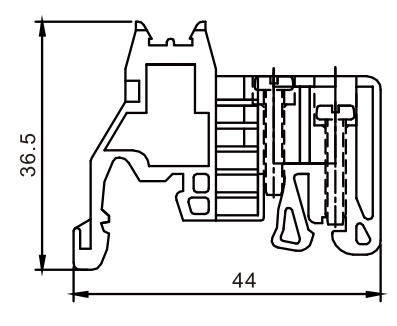 |