CT Isolation: Make-Before-Break Terminal Block Accessories
- Material:
- PA
- Flammability rating (UL 94):
- V0
- Mounting:
- Compatible with standard 32 mm or 35 mm DIN rails (EN 60715)
- General:
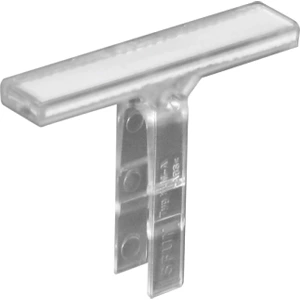
- for marking groups of terminals
- Marking field size:
- 40 mm × 17 mm
- Color:
- gray


Safe CT secondary isolation requires three mechanical guarantees. First, shorting contacts close before the measuring circuit opens. Second, a barrier prevents bridging between adjacent circuits. Third, the terminal group stays locked during test plug insertion. Follow this sequence: verify labels, check fixed bridges, lock the rail, actuate the lever slowly, and restore in reverse order. Terminal Block Accessories provide these guarantees as an integrated set.
CT Secondary Open-Circuit Risk
A CT secondary left open while primary current flows develops high voltage. That voltage can destroy insulation, ignite cable, and rupture oil-filled units. The CT tries to maintain current through infinite impedance. For a 1000:5 CT with 100 A primary, open-circuit voltage can reach thousands of volts. Isolation must create a low-impedance path before any break.
How Make-Before-Break Enforces Safety Sequence
A make-before-break terminal automates the sequence. Lever movement closes shorting contacts first. Continued travel opens the measuring circuit. The mechanism enforces order; operator error cannot reverse it. The CT winding always sees a low-impedance path during transition.
-
Move the lever until shorting contacts close.
-
Continue travel to open the measuring circuit.
-
Reverse the lever to restore the measuring circuit.
-
Remove the short only after the measuring circuit is closed.
Four Terminal Block Accessories for Anti-Mistouch Design
terminal block jumper bars
Fixed or plug-in jumper bars create a permanent short across adjacent terminals. They support multi-ratio CT circuits and act as a backup when temporary shorting plugs are removed. A bar rated for secondary current keeps the short robust under vibration.
terminal block partition plate
An isolation partition plate separates terminal groups at different potentials. It prevents accidental bridging between shorted terminals and live measuring circuits during probe placement. It also maintains creepage and clearance distances.
terminal block marker strips
Clear identification prevents wiring errors during restoration. Marker strips applied to isolation terminals let technicians verify the correct shorting point before lever actuation. A misidentified terminal in a protection circuit can open the wrong winding.
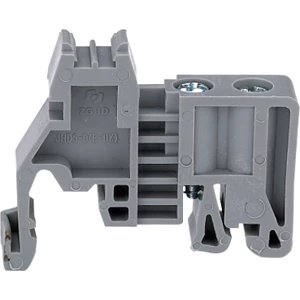
terminal end stop
An end stop locks the terminal assembly on the DIN rail. Without it, lateral movement during test plug insertion can dislodge adjacent blocks. That movement can disturb shorting links on neighboring circuits.
Selection Matrix by CT Circuit
| Component | Function | Risk if Missing |
|---|---|---|
| Shorting terminal | Short before open | Manual shorting error |
| Fixed bridge | Maintains short across taps | Open tap during switching |
| Insulating barrier | Blocks cross-circuit bridging | Accidental contact |
| Label carrier | Identifies shorting terminals | Restoration error |
| Rail lock | Locks terminal group | Displacement during insertion |
Seven-Step Field Isolation Procedure
-
Verify terminal identification against the drawing.
-
Check fixed bridge integrity and seating.
-
Confirm barrier placement.
-
Lock the rail end stop.
-
Actuate the make-before-break lever slowly.
-
Observe the shorting indication.
-
Restore in reverse and recheck.
Standards, Verification, and Maintenance
IEC 60947-7-1 defines performance for terminal blocks in low-voltage switchgear. Accessories for instrument transformer circuits must meet finger-touch safety rules. Before energization, test every isolation terminal, confirm barrier placement, and check continuity across shorting paths.
FAQ
Q: Can make-before-break terminals replace shorting links?
A: No. They enforce sequence but need a fixed bridge for multi-ratio circuits.
Q: What happens if a partition plate is missing?
A: Probe placement can bridge different potentials and cause a fault.
| Model | JHD5-B(UBE/D) |
| Number of packages | 30 |
Thickness/Height( )/Width mm )/Width mm |
19.5/48/44.5 |
| Dimensions | 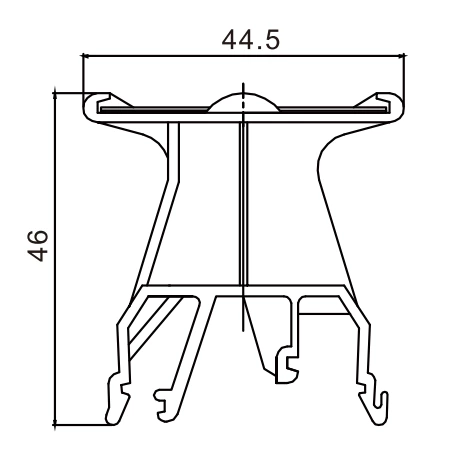 |