Screw Type Terminal Blocks Losing Contact? Copper Relaxation Explained
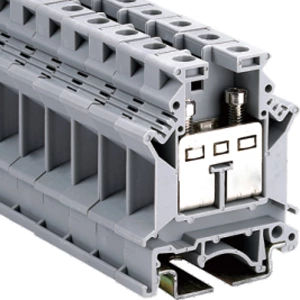
- Type:
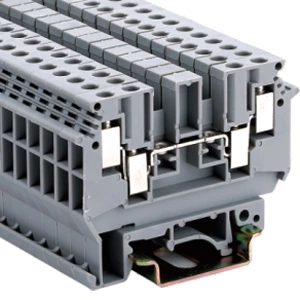
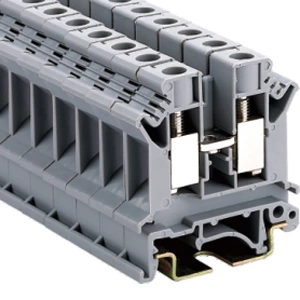
- Feed-through terminal block
- Nominal Voltage:
- 800 V
- Nominal Current:
- 57 A
- Number Of Connections:
- 2
- Connection Method:
- Screw connection
- Rated Cross Section:
- 10 mm²
- Cross Section:
- 0.5 mm² - 16 mm²
- Color:
- gray
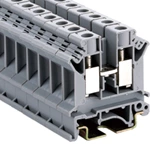
When contact resistance rises on a screw type terminal block, check three things first: torque, thermal imaging, and micro-ohm readings. If the screw turns another 2–3 rotations without discoloration, pitting, or stripped threads, treat it as copper relaxation. Replace the terminal only when heat damage or thread failure is visible.
What Copper Relaxation Does
Copper deforms under sustained clamping pressure. This creep runs at a microscopic level for years, shrinking the real contact area between conductor and current bar. The screw relaxes too, dropping axial force with no outside help.
Thermal cycling accelerates both. Copper expands at roughly 17×10⁻⁶ K⁻¹, while steel and brass differ. Each load cycle moves the joint microscopically, settling the contact and opening oxidation paths.
Three-Step Diagnostic Process
-
De-energize, lock out, and record the original torque value.
-
Use thermal imaging to locate hot spots, then a micro-ohmmeter for contact resistance.
-
Re-tighten to the manufacturer's specified torque and mark the rotation angle.
Reference thresholds below, based on IEC 60947-7-1 temperature-rise conventions and industry micro-ohm practice.
| Reading | Status | Action |
|---|---|---|
| Below 3.0 mΩ | Nominal | Continue scheduled monitoring |
| 3.0–10.0 mΩ | Warning | Re-strip wire, re-insert, re-torque |
| Above 10.0 mΩ | Failure | Replace terminal or connection method |
Layered Countermeasures
Scheduled torque verification
A calibrated torque audit at commissioning, 72 hours later, then annually catches relaxation before resistance climbs. For main feeders, move to every six months.
Integrated locking mechanisms
Screw clamp type terminals with spring-loaded locking designs hold clamping force as materials relax. The Reakdyn principle used in JHD5 series screw clamp terminal blocks creates a self-locking effect through elastic deformation of the clamping body. This cuts reliance on manual re-tightening across the terminal's service life.
Ferrules on fine-stranded conductors
Bare fine-stranded wire in a screw clamp terminal contacts through a fraction of its cross-section. A crimped ferrule consolidates every strand into one gas-tight cylinder. The screw then clamps a defined, repeatable surface. This applies to any screw terminal fuse block or feed-through block accepting flexible wire.
JHD5-10 Reference Specifications
| Parameter | Value |
|---|---|
| Rated cross-section | 10 mm² |
| Screw torque (10 mm²) | ~1.2–1.5 N·m |
| Conductor range | 0.75–25 mm² |
| Locking mechanism | Reakdyn spring self-lock |
| Housing material | UL94 V-0 rated |
These values align with the product datasheet and IEC 60947-7-1 requirements for copper conductor terminal blocks.
When to Replace Instead
Three conditions mean replacement, not another torque pass:
-
Visible discoloration or charring on the terminal body or insulation
-
Pitted or eroded contact surfaces on the current bar
-
Stripped threads, or a terminal block clamp that no longer retains the conductor
The damage here is metallurgical. A screw clamp terminal block that loosened once in a high-vibration environment will loosen faster after the first event.
Scenario Boundaries
| Condition | Re-tighten + Ferrules | Switch to Spring/Push-in |
|---|---|---|
| Low vibration, stable load | Sufficient | Optional |
| Continuous vibration | Not recommended | Required |
| Thermal cycling above 60°C | Monitor closely | Required |
| Visible contact damage | Insufficient | Required |
For panels under continuous vibration or frequent load cycling above 60°C internal temperature, spring-clamp or push-in terminations remove the screw interface from the reliability equation. The deciding factor is whether the clamping mechanism can still generate the contact force the circuit needs.
FAQ
Q: Is copper relaxation the same as a loose screw?
A: No. A loose screw is mechanical. Relaxation is time-dependent deformation of the conductor and screw under sustained pressure and heat.
Q: Must fine-stranded wire use ferrules in screw terminals?
A: Yes. Bare strands splay and make unpredictable contact. A ferrule creates a defined, gas-tight interface.
Q: When must the terminal be replaced?
A: Discoloration, pitting, stripped threads, or resistance above 10 mΩ after re-tightening.
| Model | Function | Wire IEC cross-section | Wire UL | Thickness | Maximum current | Number of packages | Thickness/Height( )/Width mm )/Width mm |
Rated voltage/rated current/rated cross-sectior |
| JHD5-10 | 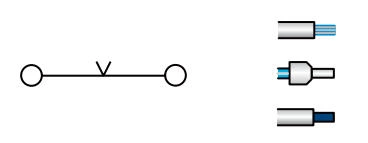 |
10 mm² 6 mm² 10 mm² |
6 AWG 10 AWG 6 AWG | 10.2 mm | 57 A | 60 | 10.2/47/42.5 | 800 V/57 A/10 mm² |
Specfication:
| End cover | D2.5-10 |
| Cross-connection 10-Polo,Separable | ZL2-10 ZL3-10 ZL10-10 |
| Insertion bridge 10-Polo,Separable | BLS2-10 BLS3-10 BLS10-10 |
| Partition plate | FP |
| Small Partition | CP |
| Marking tags | ZB10 |
| Screw/Tightening torque(Nm) | M4/1.2 |
| Material | PA |
| Flame retardant rating UL-94 | V0 |
| Dimensions | 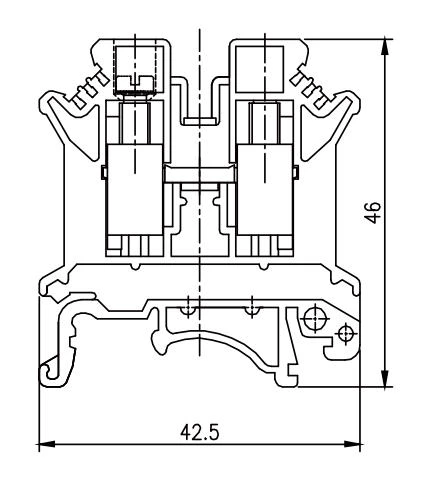 |
With universal mounting feet for standard top-hat(Ω profile) and G-profile DIN rail mounting.