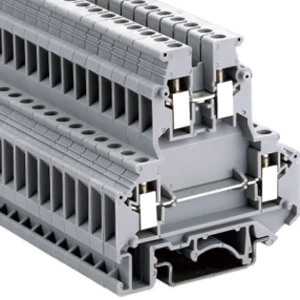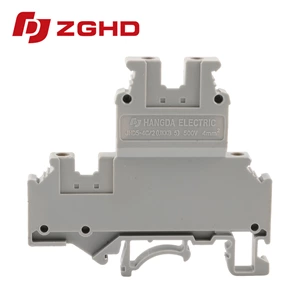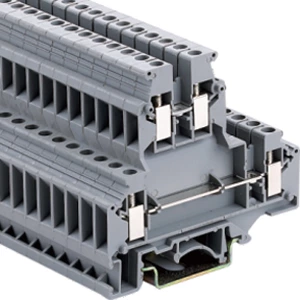
Multi-Level Terminal Blocks: Expand Cabinet Without New Enclosure
- Type:
- Double-level terminal block
- Nominal Voltage:
- 500 V
- Nominal Current:
- 24 A
- Connection Method:
- Screw connection, 1st and 2nd level
- Rated Cross Section:
- 2.5 mm²
- Cross Section:
- 0.2 mm² - 4 mm²
- Color:
- gray
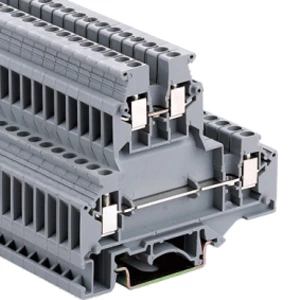
A control cabinet retrofit can double wiring capacity without a new enclosure. Use multi-level terminal blocks. Steps: document existing wiring, de-energize and isolate, remove single-level blocks, install multi-level units on the same DIN rail, migrate conductors level by level, then label and test. This method stacks two or more isolated connection levels vertically. One block handles what previously required two or three separate units. The cabinet footprint stays the same.
Multi-level terminal blocks are modular connectors that stack two or more isolated connection levels in one housing, allowing higher wiring density on the same DIN rail.
What Are Multi-Level Terminal Blocks?
Definition and Working Principle
Each level operates as an independent circuit. A double-level unit provides four connection points. A triple-level unit provides six. The levels are electrically isolated from each other.
Double-Level vs Triple-Level
Double-level blocks suit supply and signal pairs. Triple-level blocks fit dense control wiring. Both mount on standard 35 mm DIN rail profiles.
Why Retrofit Instead of Replacing the Enclosure?
- No cabinet cutting or drilling.
- No backplate replacement.
- No cable entry modification.
- Original protection rating remains.
- Downtime is limited to the rail area.
Selection Criteria
Electrical Ratings
A 2.5 mm² rated multi level terminal carries 20 A to 24 A at 500 V. Each level must meet the branch circuit requirement. Derating applies when multiple levels carry current at once.
Physical Constraints
Multi-level blocks add height, not width. Check available rail length and cabinet depth. Upper-level wire bends may reduce clearance.
Material and Protection
Housings should meet UL 94 V-0. IP20 finger-safe protection is a baseline for control cabinet use.
Step-by-Step Retrofit Procedure
-
📋 Document terminal numbers, conductor sizes, and circuit functions.
-
⚡ De-energize and isolate. Verify absence of voltage.
-
🛠️ Remove original blocks. Keep the DIN rail in place.
-
🔌 Install multi level terminal blocks from the center outward.
-
🔹 Migrate conductors level by level. Use ferrules on flexible conductors.
-
🏷️ Label and test. Perform continuity checks before re-energizing.
Before and After Comparison
| Parameter | Single-Level Layout | Two-Level Retrofit |
|---|---|---|
| Rail width for 10 circuits | 100 mm | 50 mm |
| Connection points per block | 2 | 4 |
| Cabinet modification | — | None |
| Testing access | Front only | Front and upper level |
| Potential separation | Per block | Isolated per level |
The 50% rail reduction is typical for two-level designs. Actual figures depend on block pitch and conductor size.
Commissioning Checks
✅ Verify bridging accessories are seated.
✅ Check tightening torque against specification. Values of 0.4 Nm to 0.6 Nm are common for screw-clamp versions.
✅ Confirm upper-level conductors do not obstruct labeling or test sockets.
✅ Inspect the DIN rail for corrosion or deformation if reused.
Common Mistakes During Retrofit
Overlooking Derating
Multiple levels carrying current at once may require a lower per-level load.
Mixing Level Functions
Supply and signal circuits should not share a level without isolation.
Blocking Test Sockets
Upper-level wiring can cover test access if bend radius is ignored.
FAQ
Q: What is a multi level terminal?
A: It is a modular block with two or more isolated connection levels in one housing, mounted on a DIN rail.
Q: Can a triple-level block replace three single-level units?
A: Electrically yes, if voltage and current ratings match. Physically, check upper-level wire bend radius against cabinet depth.
Q: Is a new DIN rail required?
A: Not usually. Standard 35 mm rail accepts multi-level blocks if the rail is straight and undamaged.
Q: How does labeling work with stacked levels?
A: The lower level carries the primary circuit number. Upper levels use suffixes such as 1.1 and 1.2.
| Model | Function | Wire IEC cross-section | Wire UL | Thickness | Maximum current | Number of packages | Thickness/Height( )/Width mm )/Width mm |
Rated voltage/rated current/rated cross-sectior |
| JHD5-2.5C/2 | 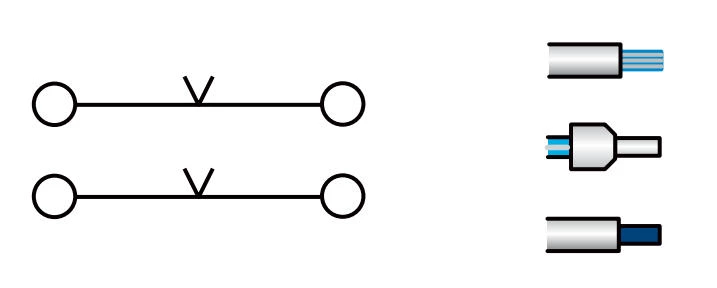 |
2.5 mm² 1.5 mm² 2.5 mm² |
14 AWG 16 AWG 14 AWG | 5.2 mm | 32 A | 100 | 5.2/62/67 | 500 V/32 A/2.5 mm² |
Specfication:
| End cover | D2.5C/2 |
| Cross-connection 10-Polo,Separable | ZL2-2.5C/2 ZL3-2.5C/2 ZL10-2.5C/2 |
| Insertion bridge 10-Polo,Separable | BLS2-2.5 BLS3-2.5 BLS10-2.5 |
| Small Partition | CPK3 |
| Marking tags | ZB5 |
| Screw/Tightening torque(Nm) | M3/0.6 |
| Material | PA |
| Flame retardant rating UL-94 | V0 |
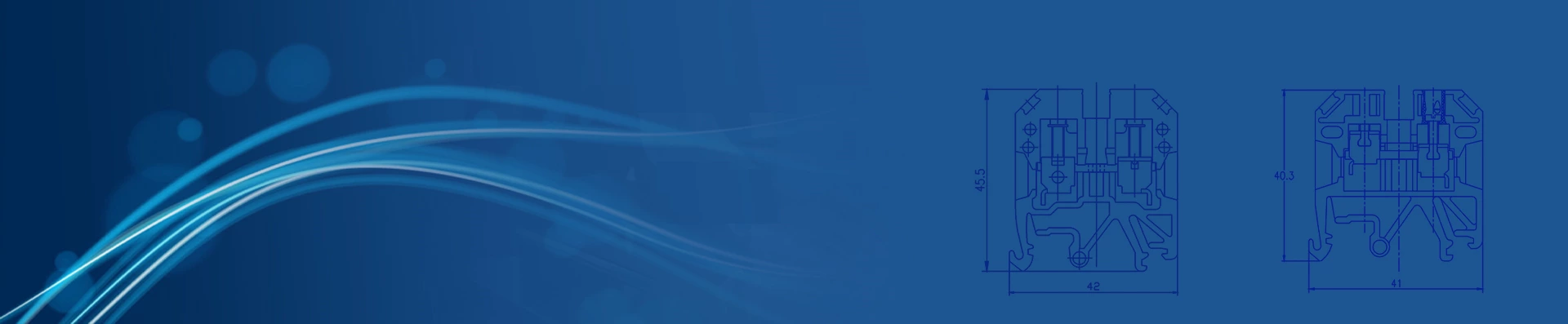
| Dimensions | 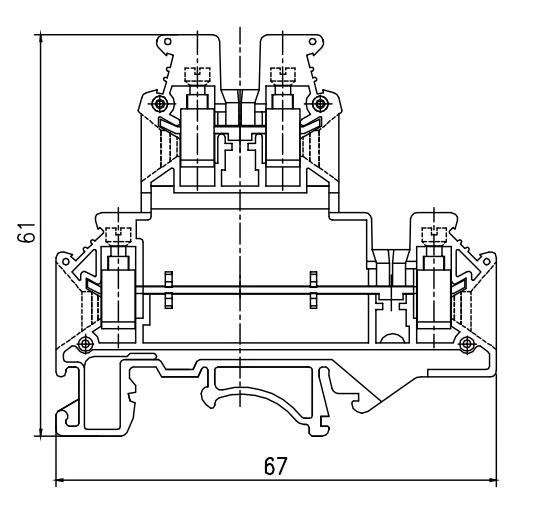 |
With universal mounting feet for standard top-hat(Ω profile) and G-profile DIN rail mounting.