Elastic Memory In Cold Shrink Cable Accessories: Active Sealing Explained
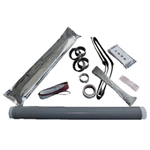
Cold shrink cable accessories use elastic memory to create an active seal. A factory-expanded rubber tube contracts onto the cable when its spiral core is removed. The rubber maintains radial pressure, so the interface adjusts through thermal cycling without heat or adhesive. Installation: 1) Prepare cable. 2) Apply mastic. 3) Position tube. 4) Pull core. 5) Confirm contact.
What Elastic Memory Means
Elastic memory is the property of cross-linked polymers returning to their original shape after temporary expansion. In cold shrink cable accessories, a spiral core holds the stretched rubber. Removing the core releases stored energy, causing radial contraction onto the cable.
Factory expansion stretches polymer chains. The core locks them in place. Pulling the core lets chains snap back. A compressed spring held by a latch acts as an analogy. Remove the latch, and stored energy releases.
How Active Sealing Works Under Thermal Cycling
Rubber keeps constant inward pressure. It expands and contracts with the cable. A cold shrinkable joint holds interface pressure under load swings. This living seal prevents moisture ingress.
Heat-shrink recovers once. After cooling, it becomes rigid. Thermal cycling can open a gap at the cable interface. Cold shrink maintains contact because the rubber stays under compression.
| Feature | Cold Shrink | Heat Shrink |
|---|---|---|
| Recovery | Elastic memory | Thermal |
| Heat source | None | Torch |
| Thermal cycling | Self-adjusting | Fixed |
| Repositioning | No | No |
Cold Shrink vs Heat Shrink: Selection Logic
Cold shrink is preferred when:
-
Open flames are prohibited.
-
Load swings are large.
-
Installation space is tight.
-
The cable must be energized soon.
Heat shrink remains suitable for low-voltage indoor work with stable thermal conditions and cost sensitivity.
Types and Selection
A cold shrinkable termination for outdoor use employs silicone rubber for UV stability. Stress control manages the electrical field at the cable end.
A cold shrinkable joint for burial or submersion uses EPDM for corrosion resistance. This cold shrinkable cable joints design resists moisture ingress and mechanical stress.
| Voltage | Conductor Range | Configuration |
|---|---|---|
| 10 kV | 25–630 mm² | Single/three core |
| 35 kV | 25–630 mm² | Single/three core |
| Property | Silicone | EPDM |
|---|---|---|
| UV | High | Moderate |
| Corrosion | Good | High |
| Hardness | 43 | 38 |
| Elongation | 700% | 700% |
Installation Steps and Common Errors
-
Prepare cable to dimensions.
-
Apply mastic seal.
-
Position tube over cable end.
-
Pull spiral core.
-
Confirm full radial contact.
| Error | Result | Check |
|---|---|---|
| Expired storage | Weak recovery | Date |
| Wrong lubricant | Rubber degradation | Spec |
| Sharp edges | Crack sites | Smooth |
| Residual core | Leak path | Full removal |
Cost Factors and Cold Shrink Tube Price
The cold shrink tube price depends on voltage rating, material grade, kit content, and conductor range. A 35 kV unit needs thicker walls and stress control than a 1 kV equivalent.
Contraction ratio above 250% lets one accessory cover multiple cable sizes. This reduces inventory needs and field assembly time.
Standards, Testing, and Service Life
Applicable standards include IEC, IEEE, and UL. Type tests cover power frequency, partial discharge, thermal cycling, and immersion. Service life is rated at 30 years for correct installation.
FAQ
Does elastic memory degrade over time?
Silicone and EPDM retain elasticity across wide temperature ranges for 30 years.
Can a cold shrinkable joint be repositioned after core removal?
No. The rubber contracts at once. Position must be checked before core removal.
What sizes do cold shrinkable cable joints cover?
Conductor ranges span 25–630 mm² depending on voltage class.
How is cold shrink tube price determined?
Voltage, material, kit content, and conductor range drive pricing.
 |
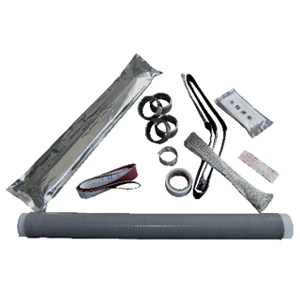 |
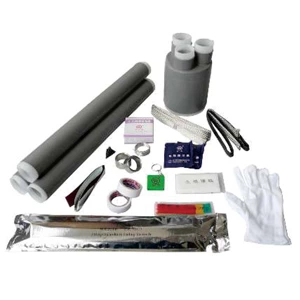
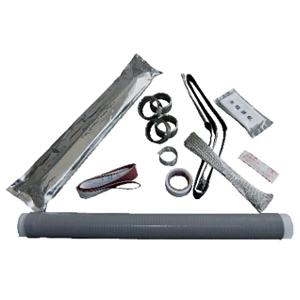
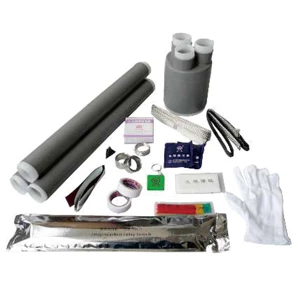
| Cold Shrink Three-Core Sealing Assembly | Cold Shrink Single-Core Sealing Assembly |
Technical Data - Model Selection
| Product Type | Model | Conductor Cross-section(mm²) | Product Type | Model | Conductor Cross-section(mm²) |
| 8.7/15 kV Single-Core Cold Shrink Preparation Parts | GHD-15ZBLS-1*25-50 | 25-50 | 12/20 kV Sing-Core Cold Shrink Preparation Parts | GHD-20ZBLS-1*35-70 | 35-70 |
| GHD-15ZBLS-1*70-120 | 70-120 | GHD-20ZBLS-1*95-150 | 95-150 | ||
| GHD-15ZBLS-1*150-240 | 150-240 | GHD-20ZBLS-1*185-300 | 185-300 | ||
| GHD-15ZBLS-1*300-400 | 300-400 | GHD-20ZBLS-1*400-500 | 400-500 | ||
| 8.7/15 kV Three-Core Cold Shrink Preparation Parts | GHD-15ZBLS-3*10-16 | 25-50 | 12/20 kV Three-Core Cold Shrink Preparation Parts | GHD-20ZBLS-3*35-70 | 35-70 |
| GHD-15ZBLS-3*25-50 | 70-120 | GHD-20ZBLS-3*95-150 | 95-150 | ||
| GHD-15ZBLS-3*70-120 | 150-240 | GHD-20ZBLS-3*185-300 | 185-300 | ||
| GHD-15ZBLS-3*150-240 | 300-400 | GHD-20ZBLS-3*400-500 | 400-500 | ||
| 18/20 kV Single-Core Cold Shrink Preparation Parts | GHD-24ZBLS-1*35-95 | 35-95 | 26/35 kV Single-Core Cold Shrink Preparation Parts | GHD-35ZBLS-1*50-120 | 50-120 |
| GHD-24ZBLS-1*120-185 | 120-185 | GHD-35ZBLS-1*150-240 | 150-240 | ||
| GHD-24ZBLS-1*240-400 | 240-400 | GHD-35ZBLS-1*300-400 | 300-400 | ||
| GHD-24ZBLS-1*500-630 | 500-630 | GHD-35ZBLS-1*500-630 | 500-630 | ||
| 18/20 kV Three-Core Cold Shrink Preparation Parts | GHD-24ZBLS-3*35-95 | 35-95 | 26/35 kV Three -Core Cold Shrink Preparation Parts | GHD-35ZBLS-3*50-120 | 50-120 |
| GHD-24ZBLS-3*120-185 | 120-185 | GHD-35ZBLS-3*150-240 | 150-240 | ||
| GHD-24ZBLS-3*240-400 | 240-400 | GHD-35ZBLS-3*300-400 | 300-400 | ||
| GHD-24ZBLS-3*500-630 | 500-630 | GHD-35ZBLS-3*500-630 | 500-630 |
