Why Terminal Blocks Must Provide Finger-safe Protection: Iec 60947-7-1 And Ip20b Compliance Explained
- Flammability rating (UL 94):
- V0
- Mounting:
- Compatible with standard 32 mm or 35 mm DIN rails (EN 60715)
- General:
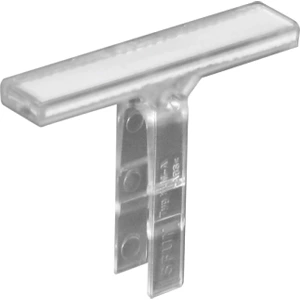
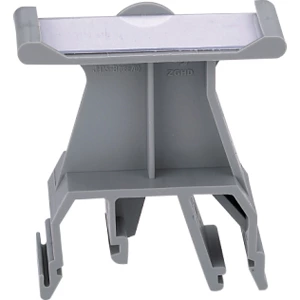
- for marking terminal group
- Lettering field size:
- 44 x 7 mm
- Color:
- gray
Finger-safe protection prevents accidental contact with live parts during maintenance and operation. IEC 60947-7-1 defines construction rules for terminal blocks. IP20B verifies finger access using a jointed test probe. Terminal block accessories close open ends, jumper slots, and bridging points so the assembled stack stays compliant.
What IEC 60947-7-1 Requires
Scope and Construction Rules
The standard applies to terminal blocks for copper conductors. It covers clamping units, mounting, marking, and dielectric properties. These clauses form the base for touch protection, even though the standard does not use the term “finger-safe.”
Clearance, Creepage, and Dielectric Checks
Clearances and creepage distances depend on pollution degree and voltage. Dielectric tests confirm insulation strength. Touch protection fails when these distances shrink or when openings expose live metal.
Where Touch Protection Enters the Standard
Constructional clauses prevent accidental contact. National and regional rules then reference IP ratings to verify finger access. Compliance starts with the block, but assembly determines the final boundary.
IP20B vs IP20 vs IPXXB
| Rating | Solid Object | Finger Access | Test Probe | Typical Use |
|---|---|---|---|---|
| IP20 | >12.5 mm | Not verified | None | General enclosures |
| IP20B | >12.5 mm | Verified | Jointed test finger | Finger-safe terminal blocks |
| IPXXB | Varies | Verified | Jointed test finger | Touch-proof assemblies |
IP20B adds finger-access verification to IP20. A jointed test finger with a 50 mm by 20 mm stop face must not touch live parts. IPXXB applies the same probe without specifying solid-object protection.
Why a Finger-Safe Block Can Fail in an Assembly
A block rated IP20B can lose that rating once mounted. Open ends expose live metal. Jumper slots create gaps. Mixed accessories with different protection levels break the boundary. Testing the assembled stack, not just single components, reveals these failures.
How Terminal Block Accessories Restore the IP20B Boundary
Terminal block accessories close the openings that individual blocks leave behind. End plates cover live ends. Partition plates separate circuits. Marker carriers and insulated covers protect marking areas. Insulated jumpers bridge circuits without exposing conductors. Selection must match the block’s voltage, current, and protection rating.
| Accessory Type | Protection Function | Mounting Method | Selection Check |
|---|---|---|---|
| End plate | Closes live end | Direct on rail | Matches block width |
| Partition plate | Separates circuits | Snap-on | Voltage rating |
| Marker carrier | Insulates marking area | Plug-in | Temperature range |
| Insulated jumper | Bridges circuits | Screw or push-in | Current rating |
End Plates and Partition Plates
End plates mount on the last block in a stack. They prevent contact with live parts at the open end. Partition plates isolate adjacent circuits at different potentials.
Marker Carriers and Insulated Covers
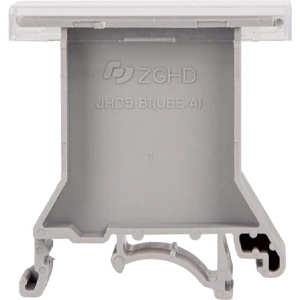
A marker carrier such as the JHD5-B1 UBE-A uses PA66 with UL94 V-0 flame rating. It operates from -40°C to +105°C and snaps onto standard DIN rail blocks. The carrier keeps labels isolated from live contacts.
Product Example
This carrier fits terminal blocks with a 5 mm pitch. Its insulated body maintains the IP20B boundary when installed correctly. Always confirm compatibility with the specific block series.
Jumper Selection for Touch-Safe Circuits
terminal jumper Risks
A bare terminal jumper crosses insulation boundaries. It exposes live metal at each bridging point. That exposure voids finger-safe protection even when blocks are individually rated.
terminal jumper bar Insulation
An insulated terminal jumper bar maintains the IP20 boundary across connected blocks. The insulation must match the block’s voltage and current ratings. Verify the jumper’s temperature rating against the application.
terminal block jumper bar Matching
A terminal block jumper bar must fit the block’s pitch and terminal design. Mismatched bars create gaps or loose contacts that fail the jointed test finger.
barrier strip jumper in Barrier Assemblies
A barrier strip jumper performs the same bridging function in barrier-style assemblies. Insulated versions prevent live parts from becoming accessible during maintenance.
Compliance and Assembly Checklist
-
Confirm each block meets IEC 60947-7-1 construction clauses.
-
Verify IP20B with a jointed test finger at all openings.
-
Install end plates on both ends of every stack.
-
Use insulated jumper bars instead of bare metal links.
-
Match accessory protection ratings to the block.
-
Re-test the assembled stack, not only single components.
Common Misconceptions
-
An IP20 block does not guarantee a finger-safe assembly.
-
IP20 and IP20B are not identical.
-
An insulated jumper cannot replace end plates.
-
Single-component certification does not cover assembly gaps.
FAQ
Q: Does IP20B equal finger-safe?
A: IP20B verifies finger access under test conditions. It does not cover every maintenance scenario, but it is the standard rating for touch-safe terminal blocks.
Q: Is IP20B mandatory under IEC 60947-7-1?
A: The standard provides construction rules. The required protection level comes from the product specification and installation environment.
Q: Can an insulated terminal jumper bar replace end plates?
A: No. End plates close open ends. Jumper bars bridge circuits. Both are needed for a complete boundary.
Q: How is an assembled terminal stack tested?
A: A jointed test finger is applied with specified force. If it touches live parts, the assembly fails.
| Model | JHD5-B1(UBE/A) |
| Number of packages | 40 |
Thickness/Height( )/Width mm )/Width mm |
15.5/45.3/44 |
| Dimensions | 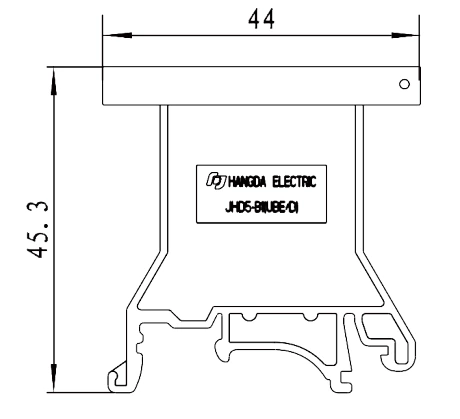 |