Disconnect & Test Terminal Blocks: Safe Isolation From Arc Flash
- Type:
- Test disconnect terminal block, with two test sockets for 4 mm test plugs, or for receiving bridge bars or screw bridges
- Nominal Voltage:
- 400 V
- Nominal Current:
- 41 A
- Connection Method:
- Screw connection
- Rated Cross Section:
- 6 mm²
- Cross Section:
- 0.5 mm² - 10 mm²
- Color:
- gray
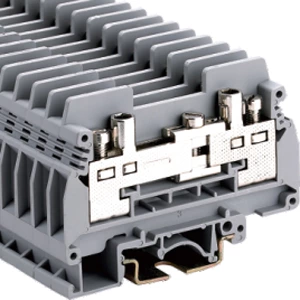
A disconnect & test terminal block is a DIN-rail mounted device that isolates a circuit and provides test access without loosening live wires. It reduces arc flash, short circuit, and shock risk by keeping the disconnection point inside an insulated housing. The mechanism opens and closes at a defined lever, so no conductor is exposed during measurement or maintenance.
Why Live Testing Remains Hazardous
Commissioning and maintenance tasks often require voltage checks or signal injection while a panel stays energized. Shutting down every circuit for a quick test is impractical when the system must run to confirm functionality.
An OSHA accident report describes an arc flash that occurred when a worker touched a fuse with tester electrodes. The blast threw the employee back about 1.8 meters and caused burns. A momentary slip near live parts can escalate fast.
A knife terminal addresses this by housing the disconnection point inside an insulating body. The operator uses a screwdriver at a marked lever. No loose wire end is created.
How Isolation and Testing Work Without Wire Removal
Knife Disconnect Mechanism
A knife terminal block uses a sliding blade or lever to open the current path. The action happens inside the insulating housing, so no live metal becomes reachable. The circuit sits either fully connected or fully separated at a marked position.
Integrated Test Sockets
Test-disconnect models include test sockets in front of and behind the disconnection area.
-
Sockets accept 4 mm test plugs
-
Measurement works on either side of the open point
-
No wiring is disturbed during voltage or current checks
Cross-Connection Flexibility
Many designs offer cross-connection channels on each level. Potential distribution or signal multiplication continues while the disconnection function stays independently operable. This supports circuits that need both isolation and shared reference points.
Ratings and Construction Data
| Parameter | Typical Value |
|---|---|
| Rated voltage | 400 V |
| Rated current | 41–57 A |
| Rated cross-section | 6 mm² (0.5–10 mm² range) |
| Connection method | Screw (M4, 1.2 Nm torque) |
| Housing material | PA, UL-94 V0 flame retardant |
| Mounting | DIN rail (top-hat and G-profile) |
These figures reflect one common configuration. Verify that the chosen knife terminal block matches the circuit's actual voltage, current, and wire gauge before installation.
When a Non-Disconnecting Type Terminal Block Fits
A non disconnecting type terminal block provides a continuous connection with no opening function. It suits circuits where isolation is never needed during normal operation and where an extra mechanism would add cost or occupy DIN rail space.
Using a feed-through terminal where repeated isolation is required forces technicians to loosen wires as a workaround. That practice creates the loose-conductor condition disconnect terminals are built to prevent. Match the terminal function to the circuit's maintenance profile first.
Selection Checklist
-
Confirm whether the circuit needs repeated isolation during commissioning or maintenance.
-
Check voltage, current, and wire cross-section against the terminal ratings.
-
Verify touch protection and flame retardant rating for the environment.
-
Decide whether test sockets are needed on one side or both sides of the disconnect point.
-
Record the normal state, test state, and restored state for every disconnect terminal in the panel schedule.
A knife type terminal block simplifies this process because the open and closed positions are visible and repeatable.
Installation, Testing, and Maintenance
Follow a fixed sequence for every isolation task:
-
Confirm the circuit is de-energized or that live testing is authorized.
-
Open the knife lever to separate the circuit.
-
Insert test plugs into the sockets and take readings.
-
Close the lever to restore the connection.
-
Log the normal, test, and restored states.
Inspect test sockets for contamination, check screw torque, and verify lever operation during scheduled maintenance. Replace any terminal with a cracked housing or loose blade.
Standards and Compliance
Relevant standards include IEC 60947-7-1, UL 1059, NFPA 70E, and OSHA 1910.333. An open knife is a circuit state, not proof of lockout or an electrically safe work condition. The terminal supports a broader energy-control procedure that includes verification, lockout/tagout, and authorized personnel judgment.
Frequently Asked Questions
Q: What is a disconnect & test terminal block?
A: It is a DIN-rail terminal that isolates a circuit and provides test access without removing wires.
Q: How does a knife terminal block isolate a circuit?
A: A lever or blade opens the current path inside an insulated housing.
Q: When should a non disconnecting type terminal block be used?
A: Use it where isolation is never required during normal operation.
Q: Can I test without removing wires?
A: Yes. Test sockets allow measurement on either side of the open point.
| Model | Function | Wire IEC cross-section | Wire UL | Thickness |
| JHD5-6S | 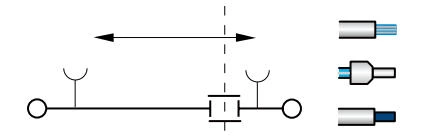 |
4 mm² 6 mm² 4 mm² |
10 AWG 12 AWG 10 AWG |
8.2 mm |
| Maximum current | Number of packages | Thickness/Height( )/Width mm )/Width mm |
Rated voltage/rated current/rated cross-sectior |
| 57A | 45 | 8.2/51.5/72 | 400 V/57 A/6 mm² |
Specfication:
| End cover | D6S |
| Cross-connection 10-Polo,Separable | ZL2-6S ZL3-6S ZL10-6S |
| Small Partition | CP6S |
| Marking tags | ZB8 |
| Screw/Tightening torque(Nm) | M4/1.2 |
| Material | PA |
| Flame retardant rating UL-94 | V0 |
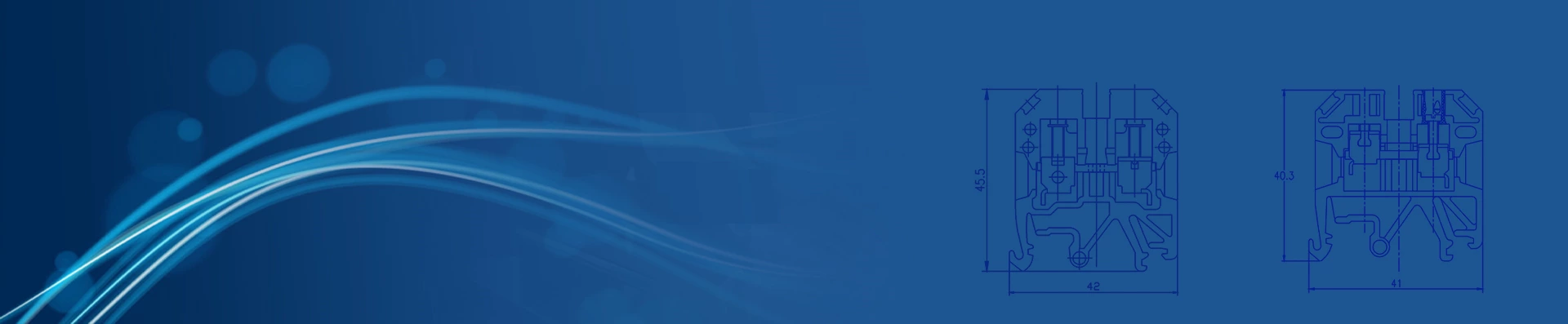
| Dimensions | 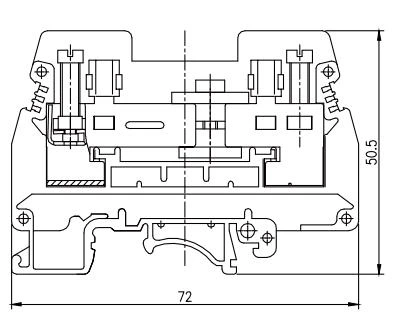 |
With universal mounting feet for standard top-hat(Ω profile) and G-profile DIN rail mounting.